
· by Michael Blair, Nashville's Handyman Service
Most of the carpentry we are called for is not a new built-in or a remodel. It is a stair tread that pops underfoot, a baluster that spins when a child leans on it, a strip of baseboard that has pulled a finger’s width off the wall, a door that latches only if you lift it, a closet rod bowed under winter coats. These are small jobs, which is why they sit on a list for years, and they are also the jobs where a quick fix with glue and a few brads looks fine for a month and then comes back. Here is how our carpentry crews approach each one, and where the rules for stairs and guards decide what a repair has to be.
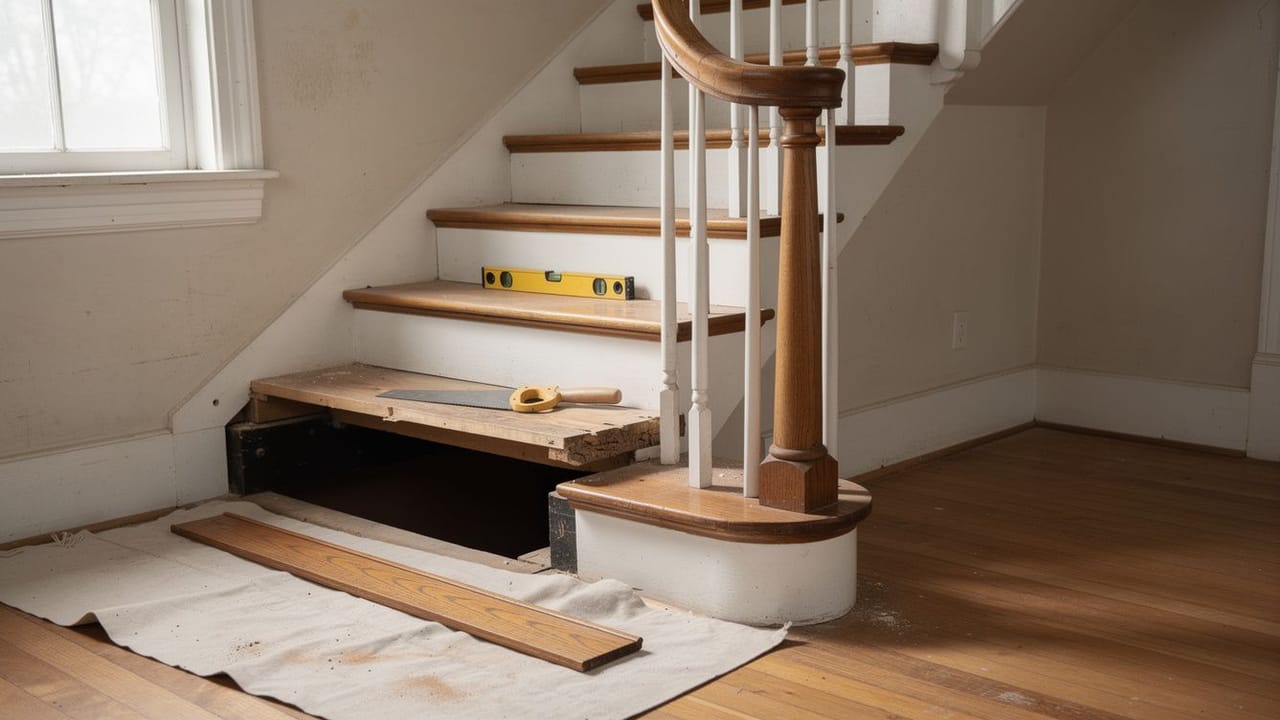
Stair treads, squeaks and loose balusters
A squeak on a stair is wood rubbing on wood or on a nail: the tread has shrunk away from the riser or stringer, or the glue blocks underneath have let go. When the underside is open, from a basement or a closet under the stairs, the lasting fix is from below: new glue blocks or a screwed cleat that pulls the tread and riser back together. When the underside is finished, we drive screws down through the tread into the stringer, countersink them and plug or fill the holes so they disappear under the finish. Squirting glue or powder into the gap from above quiets it for a season at most.
A loose baluster is nearly always a failed joint at the top or bottom, a dowel that has shrunk in its hole or a toenail that has pulled out of the rail. We take it out, clean the old glue from the joint, and reset it with fresh glue and a fastener the next person will not see. A newel post that moves is a different matter, because the whole rail depends on it; that one gets opened up and anchored to the framing, not shimmed.
Stairs and guards are also where a repair has to respect the code. The model code most of Middle Tennessee builds to, the International Residential Code, has long limited a riser to 7 3/4 inches and required a tread at least 10 inches deep, with no more than 3/8 inch of difference between the largest and smallest in a flight (2018 IRC R311.7.5, as Tennessee publishes it). That variance matters on a repair: a tread replaced with a thicker board, or a step built up with new flooring, can throw one riser out of line with the rest, and an uneven step is exactly where people trip.
Guards and baluster spacing
When balusters are missing or a section of guard has to be rebuilt, the spacing is not a matter of taste. The same edition of the IRC sets guards at 36 inches high on open-sided floors and landings, or 34 inches along the open side of a stair measured from the line of the nosings, and it does not allow openings a 4 inch sphere can pass through, with a 4 3/8 inch limit on the open side of a stair and 6 inches at the triangle formed by the riser, tread and bottom rail (IRC R312.1.2 and R312.1.3). Those figures are the model code’s long-standing rule, quoted from the 2018 text.
Metro Nashville now enforces the 2024 edition of the IRC with its own local amendments (Metro Codes’ adopted codes list), and the counties around it set their own adoptions. So when a repair turns into new work, a new rail, a rebuilt stair or a guard on a deck or landing that never had one, we check the current text with the local codes office before we cut anything. A stair rebuild with structural changes may also need a permit and a licensed contractor; what a handyman cannot legally do here covers where that line falls.
Baseboard, casing, jambs and closets
Gaps at baseboard and door casing come from two places: the house has moved a little, or the trim was nailed only into drywall and has worked loose. Caulk hides a hairline gap on paint-grade trim. A wider one means the trim needs to come back to the wall, nailed into studs and the bottom plate, and if the floor has dropped below it, a shoe molding scribed to the floor closes the gap without moving the baseboard. Mitered outside corners that have opened get pulled together, glued and pinned, not just filled.
A door that will not latch is usually a strike plate problem rather than a door problem. If the latch hits high or low, the strike is moved and the mortise extended or filled, and a jamb split by a kicked door or a forced entry is glued and clamped, then reinforced behind the strike so the screws bite into solid wood. If the whole door has dropped or binds along an edge, start with why doors stick and how to read where they rub; a strike adjustment on a sagging door only hides the cause.
Closet rods and shelves sag for one reason: the span is too long for the rod or the shelf, or the brackets are screwed into drywall alone. We find the studs, set the cleats and brackets into them, and add a center support on a long run. Wire shelving pulling out of the wall gets the same treatment, with the anchors replaced by fasteners into framing wherever the studs allow.
Epoxy or new trim, and matching an old profile
Interior trim damaged in one spot, a chewed corner on a casing, a gouge from a moving dolly, a soft patch at a bathroom door from years of splashing, is often better repaired than replaced, especially when the profile is no longer made. A two-part wood epoxy is the material that lasts: one widely used product, WoodEpox, mixes 1:1, gives about 20 minutes of working time, goes on between 50 and 90 degrees, and sands and shapes like wood once it cures (Abatron’s WoodEpox product page). Shaped to the molding and painted, the repair does not show. Where the damage runs the length of a piece, or the wood is soft from a leak that has not been fixed, the piece comes out.
Older Nashville houses, from the early bungalows to the postwar ranches, have casing and base profiles that a home center does not stock. The National Park Service guidance on historic interiors puts retaining and repairing original features such as millwork ahead of replacing them (NPS Preservation Brief 18), and the practical reason matches the preservation one: a repaired original matches the rest of the room, and a near-match from the store reads as a patch. When a piece has to be replaced, we take a sample from a closet or a hidden end, look for the closest stock profile, and build it up from two moldings or have a short run milled when nothing comes close. Painted exterior trim is a separate job, covered in rotted window trim and sills.
Sources
- International Residential Code 2018 (Tennessee), Chapter 3, R311.7.5 and R312.1 — Riser, tread and variance limits; guard heights and opening limits. 2018 edition text.
- Metro Nashville Codes, Adopted Codes for Metro Nashville — Metro enforces the 2024 IRC with local amendments.
- Abatron (UC Coatings), WoodEpox structural epoxy — Mix ratio, pot life, application temperature, sands like wood.
- National Park Service, Preservation Brief 18: Rehabilitating Interiors in Historic Buildings — Retaining and repairing original interior features such as millwork comes first.