
· by Michael Blair, Nashville's Handyman Service
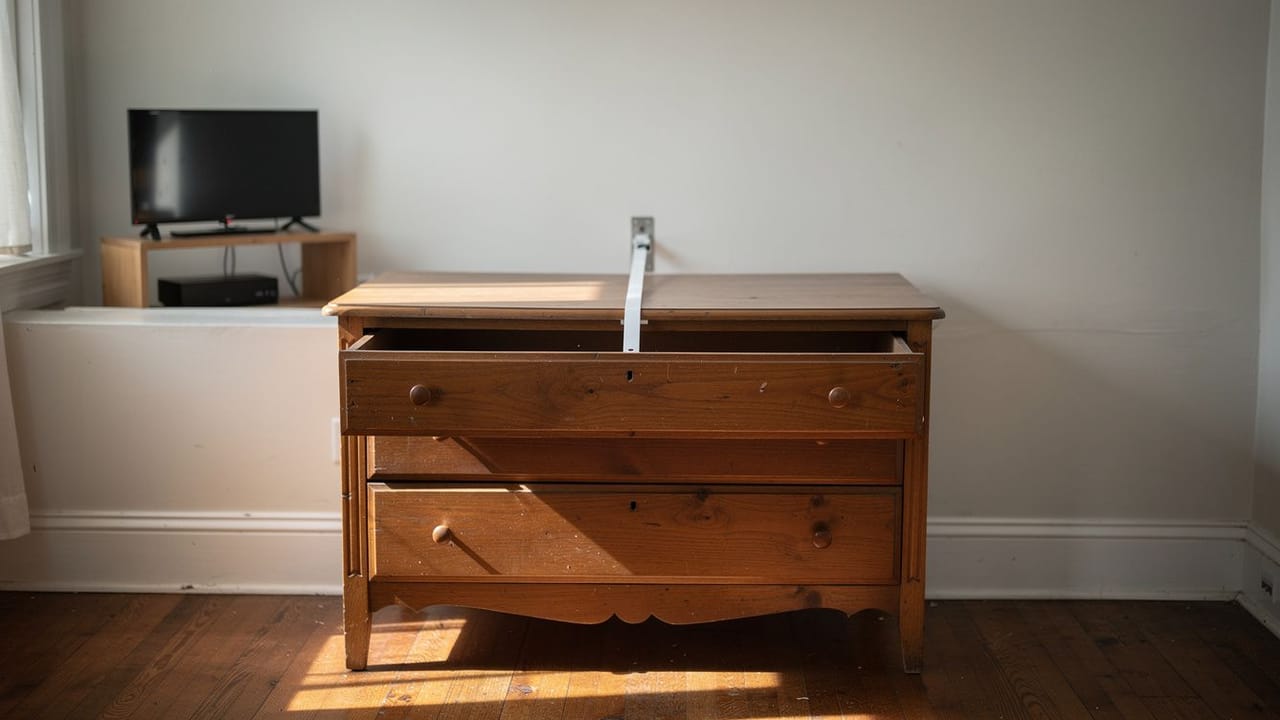
Most dressers and bookcases go against a wall and are never thought about again. They feel solid because they have never moved. The trouble is the way they fail: not by sliding, but by tipping forward once the weight shifts to the front, which is what happens when the top drawers are pulled out, when a TV sits near the front edge of a stand, or when a child uses the drawers as a ladder. The fix is a small strap or bracket, and most of the time it is already in the box. This is how we think about it when a family that has just moved in asks us to do it along with the rest of the list.
Why anchor a dresser or TV that has never moved?
Because tip-overs injure thousands of people every year, and children account for a large share of them. The U.S. Consumer Product Safety Commission estimates that 17,800 people a year were treated in emergency rooms for injuries from furniture, TV and appliance tip-overs from 2020 through 2022, with children under 18 making up 44 percent of those injuries (CPSC, February 2024 release on TV and furniture tip-overs). The same release counts 217 reported tip-over deaths from 2013 through July 2023, 137 of them children.
A heavy piece is not safer for being heavy. Its weight is what does the harm once it starts forward, and a dresser with every drawer full is at its most top-heavy the moment the upper ones are open. That is why the agency’s advice is the same for a tall bookcase, a chest of drawers and a television: fasten it to the wall.
What does an anti-tip kit actually do?
It ties the top of the furniture to the wall so the piece cannot pitch forward. The kit is a strap, cable or metal bracket, a screw for the furniture and a fastener for the wall. On a new dresser it usually comes in the box, and the CPSC’s Anchor It page says to install it right away; for older furniture it notes that inexpensive anti-tip brackets do the same job, and it tells you to follow the manufacturer’s instructions for the kit (CPSC, AnchorIt.gov).
Dressers and armoires sold since September 2023 also have to meet a mandatory federal stability standard under the STURDY Act, and the agency reports a nearly 50 percent decline in tip-over injuries and deaths over the ten years of its campaign (CPSC, Anchor It campaign at ten years, July 2025). A newer, more stable dresser still ships with its wall anchor, and the strap is still part of putting it together. When we do furniture assembly, it goes on before the drawers go in.
How do we anchor a dresser, bookcase or TV?
We fasten the strap high on the back of the piece and into the framing behind the drywall or plaster, not just the wall surface. Before drilling we find what is actually there. A newer Middle Tennessee house is usually drywall over wood studs; an older one in East Nashville or Inglewood may be plaster on lath, with framing that does not fall where you would guess. The wall side of the kit is only as good as what its screw bites into, which is the same reasoning behind hanging heavy things without damaging walls.
The furniture side matters just as much. Many dressers have a thin back panel, so the strap goes into the solid top rail or the side frame where the kit’s instructions put it, not into the hardboard. A bookcase gets a strap or bracket near the top of each tall unit. A television that is not on the wall still gets anchored, and the CPSC is specific that it should sit only on furniture made to hold a TV, pushed back from the front edge, with its cords out of reach (CPSC, AnchorIt.gov). If you would rather have the TV off the stand entirely, that is a TV and wall mounting job, and it removes the stand from the problem.
- Strap at the top back of the piece, into the top rail or side frame
- Wall fastener into framing, located before drilling
- Slack taken out so the piece cannot lean forward
- Heaviest things in the bottom drawers and on the lowest shelves
- Nothing on top that invites a child to climb for it
When the wall will not take a screw
Some walls are a problem: a brick or stone fireplace wall, a built-in, a rented apartment where the lease limits holes, or a piece that sits in front of a window. In those cases the CPSC’s fallback advice is to put a TV on a sturdy, low base pushed as far back as it will go, keep cords out of reach, and move heavier items to lower shelves and drawers (CPSC, February 2024 release). Sometimes the answer is to move the dresser to a wall that will hold it.
There is a second reason Tennessee households get this advice. The Tennessee Emergency Management Agency points out that the state has two seismic zones, the New Madrid zone in the west and the East Tennessee zone in the east, and it tells residents to secure bookcases, refrigerators, water heaters and televisions and to store heavy objects on low shelves (TEMA, Earthquake Awareness Month). The same strap answers both.
Anchoring is a short job and an easy one to add to a visit that is already about rental and move-in turnovers or a stack of flat-pack boxes. Count the pieces, note which walls they stand on and what the walls are made of if you know, and send us the list; we will price the visit and bring the right fasteners.
Sources
- U.S. Consumer Product Safety Commission, Ahead of Sunday’s Game, CPSC Reminds Families to Tackle the Deadly Hazard of TV and Furniture Tip-Overs (February 2024) — An estimated 17,800 emergency-treated tip-over injuries a year (2020–2022), 44 percent children; 217 reported deaths 2013 through July 2023; anchor TVs and furniture, and the fallback steps where you cannot.
- U.S. Consumer Product Safety Commission, AnchorIt.gov — Install the included anti-tip device right away, anchor existing furniture with anti-tip brackets, anchor TVs that are not wall mounted, use furniture designed for a TV, follow the manufacturer’s instructions.
- U.S. Consumer Product Safety Commission, Anchor It! campaign marks ten years (July 2025) — Nearly 50 percent decline in tip-over injuries and deaths over the campaign; the STURDY Act standard for clothing storage units took effect September 2023.
- Tennessee Emergency Management Agency, February is Earthquake Awareness Month (February 2024) — Tennessee’s two seismic zones; secure bookcases, refrigerators, water heaters and televisions; store heavy objects on low shelves.
FAQ
Anchoring Dressers, Bookcases and TVs to the Wall — questions
How do you anchor a dresser to the wall?
Attach the strap or bracket from the kit to the top rail or side frame at the back of the dresser, then fasten the other end into the wall framing, not just the drywall or plaster surface. Take out the slack so the dresser cannot lean forward, and follow the instructions that came with that kit.
How do you anchor a bookshelf to the wall?
Each tall bookcase gets its own strap or bracket near the top of the back, fastened into the framing behind the wall. Put the heaviest books on the lowest shelves, keep nothing on top that a child would climb for, and check that the case is not leaning forward before the strap is tightened.
Do you need to anchor a dresser that is heavy?
Yes. Weight does not stop a dresser from tipping once the top drawers are open or a child climbs the front; it is what makes the fall dangerous. Federal safety guidance says to anchor dressers and bookcases to the wall, and a new dresser usually comes with the anchor in the box for that reason.
Where do you anchor a TV that is not wall mounted?
A TV on a stand still gets strapped to the wall behind it, from the anchor points on the back of the set. It should sit only on furniture made to hold a television, pushed back from the front edge, with the cords out of reach. Mounting it on the wall removes the stand from the equation.
What are anti-tip furniture straps and do they work?
They are short straps, cables or brackets that tie the top of a dresser, bookcase or TV to the wall so it cannot pitch forward. They work when the wall end is fastened into framing and the furniture end goes into solid wood, as the kit directs. Fastened only into thin backing or bare drywall, they can pull loose.