
· by Michael Blair, Nashville's Handyman Service
Anchors fail when the load is more than the anchor was rated for, or when the wall is weaker than the rating assumes. What holds depends on the wall, the load and whether the load is pulling out or hanging down, and on most of our mounting and installation jobs the fixing is chosen before anyone picks up a drill.
Should a TV mount go into studs?
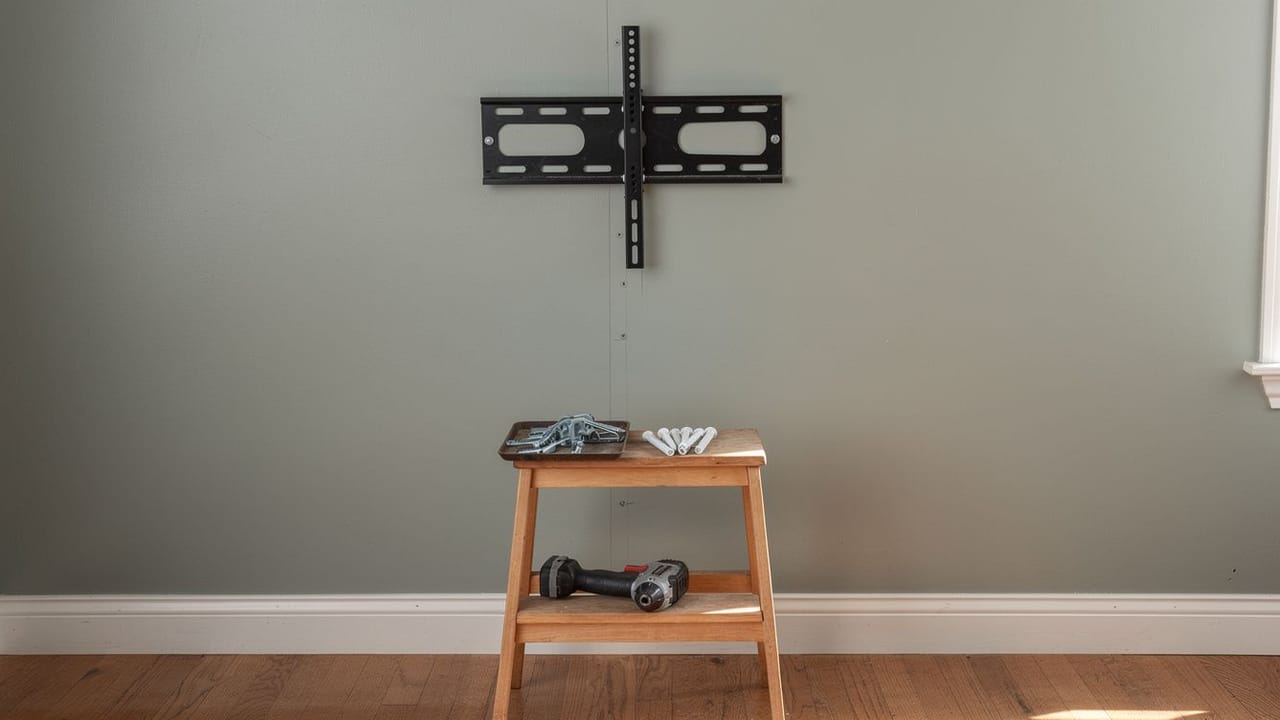
For a television, the mount’s maker usually settles it, and many name studs or masonry. Sanus’s installation manual for its VLT5 mount covers wood stud, solid concrete and concrete block walls, says in capitals not to install into drywall alone, and asks for a wall that can carry five times the weight of the TV and mount combined. We hold cabinets and shelves that carry real weight to the same standard and reach a stud wherever the layout allows.
How far apart the studs sit depends partly on the drywall. The Gypsum Association’s GA-216 application standard limits 3/8-inch panels to framing no more than 16 inches on center and lets 1/2-inch and 5/8-inch panels go on framing up to 24 inches apart, so a wall can be framed either way. We find one stud, measure to the next, and confirm each with a small test hole the bracket will cover.
Anchors by holding power
Plastic expansion plugs are the anchors we trust least, and we keep them for light pictures. Self-drilling threaded anchors sit in the middle: ITW Buildex’s E-Z Ancor drywall anchor data sheet gives its Twist-N-Lock an average of 75 lb in 1/2-inch board and its E-Z Toggle 85 lb. Strap toggles hold the most, and the SNAPTOGGLE technical bulletin from Toggler lists 120 kg, about 265 lb, for its BM6 pulled straight out of 12.5 mm drywall.
Both makers say plainly that these are laboratory numbers. ITW calls its figures averages that change with the age, moisture content and surface treatment of the board, and Toggler says industry safety standards recommend a quarter of the ultimate test load, which brings that 120 kg down to about 30 kg, roughly 66 lb. Toggler also warns that an enlarged hole reduces how well the anchor works, so we drill to the size the maker specifies, and on anything heavy we use several fixings instead of trusting one. If an anchor has already torn out, our post on patching drywall so the repair disappears covers putting the wall right.
- Anything heavy: fix into a stud
- Light picture: a picture hook or a plastic plug
- Moderate load: self-drilling threaded anchor
- Heavy load off-stud: strap toggle, counted at a quarter of its printed rating
- Plaster and lath: pre-drill, never hammer
Plaster is different
Many older houses have plaster over wood lath instead of drywall. The National Park Service’s Preservation Brief 21 on repairing flat plaster describes the lath as narrow, thin strips of wood with spaces in between, nailed across the framing, and it warns that overloading and structural movement can make the plaster come away from the lath, which it calls losing its key.
That is why we pre-drill plaster at the hole size the anchor calls for and never hammer a fixing in. For anything with weight we use toggles, and Toggler lists plaster among the walls its SNAPTOGGLE is made for.
How do you drill into tile without cracking it?
Tile is drilled with the hammer action switched off. Bosch’s guide to drilling in tiles calls for a new masonry bit or a specialized tile bit, and to keep the bit from skating it suggests first scratching the tile carefully with a nail or a punch. Before any of that, Bosch says to make sure there are no cables or pipes behind the spot, and it names a metal finder for the check.
Once the bit is through the tile and the wall behind is concrete, Bosch says the impact can go back on, with a masonry bit only. Where we can, we drill through the grout joint between two tiles, as Bosch also advises, since we would rather fill a hole in grout later than replace a cracked tile. If you have something heavy to hang on tile or plaster, tell us what it is and where it goes and we will price the job.
Sources
- Sanus, VLT5 TV Mount Installation Manual (2020) — Wood stud, solid concrete or concrete block only; do not install into drywall alone; wall must carry five times the TV and mount weight
- Gypsum Association, GA-216-2010 Application and Finishing of Gypsum Panel Products — Maximum framing spacing: 16 inches on center for 3/8-inch panels, up to 24 inches for 1/2-inch and 5/8-inch panels
- ITW Buildex, E-Z Ancor Drywall Anchors data sheet — Twist-N-Lock 75 lb and E-Z Toggle 85 lb laboratory averages in 1/2-inch board; values change with age, moisture and surface treatment
- Toggler (Mechanical Plastics Corp.), SNAPTOGGLE Technical Bulletin — BM6 120 kg tensile in 12.5 mm drywall; design at 1/4 of ultimate load; enlarged holes reduce effectiveness; strength falls with load distance from the wall; plaster and TV mounts listed as applications
- National Park Service, Preservation Brief 21: Repairing Historic Flat Plaster — Lath as narrow strips with spaces between, nailed to the framing; overloading and movement make plaster lose its key
- Bosch Power Tools, Drilling in tiles — Impact off; masonry or tile bit; scratch the tile to stop slipping; check for cables and pipes; drill the joint; impact back on for concrete behind
FAQ
Hanging Heavy Things Without Damaging Walls — questions
Can I hang a TV without hitting studs?
Some anchors are made for it: Toggler lists flat-panel TVs and TV mounts among the uses for its SNAPTOGGLE strap toggles. Many mounts rule it out, though. The Sanus VLT5 manual says not to install into drywall alone and asks for a wall that can carry five times the weight of the TV and mount together. Read the manual for your own mount first, and if it names studs, concrete or block, follow it.
What anchor should I use in plaster walls?
We use toggles, with the hole pre-drilled to the size the maker specifies and nothing hammered in. Toggler lists plaster among the SNAPTOGGLE’s applications. Plaster over lath is held on by its key, and the National Park Service notes that overloading and movement can break that key and let the plaster come away from the lath.
How much weight can a drywall anchor hold?
It depends on the anchor and the board. ITW’s laboratory averages in 1/2-inch drywall are 75 lb for its Twist-N-Lock and 85 lb for its E-Z Toggle, and Toggler lists about 265 lb for its BM6 strap toggle pulled straight out. Those are test figures, not working loads. Toggler says industry safety standards recommend a quarter of the ultimate test load, and that holding strength drops the farther the load sits from the wall.
Why are my drywall anchors pulling out?
Usually the load is more than the anchor really carries, or the wall is weaker than its rating assumes. Printed figures are lab averages that shift with the board’s age and moisture, an oversized hole weakens the grip, and holding strength falls as the load moves out from the wall. Count a quarter of the rating, or find a stud.