
· by Michael Blair, Nashville's Handyman Service
A handyman covers the enormous middle ground between jobs too small for a specialist and jobs beyond a homeowner. Knowing where that ground ends saves both money and trouble, and in Middle Tennessee the edge is drawn by two things you can check: whether the job needs a permit, and what the whole project costs.
What is a handyman the right call for?
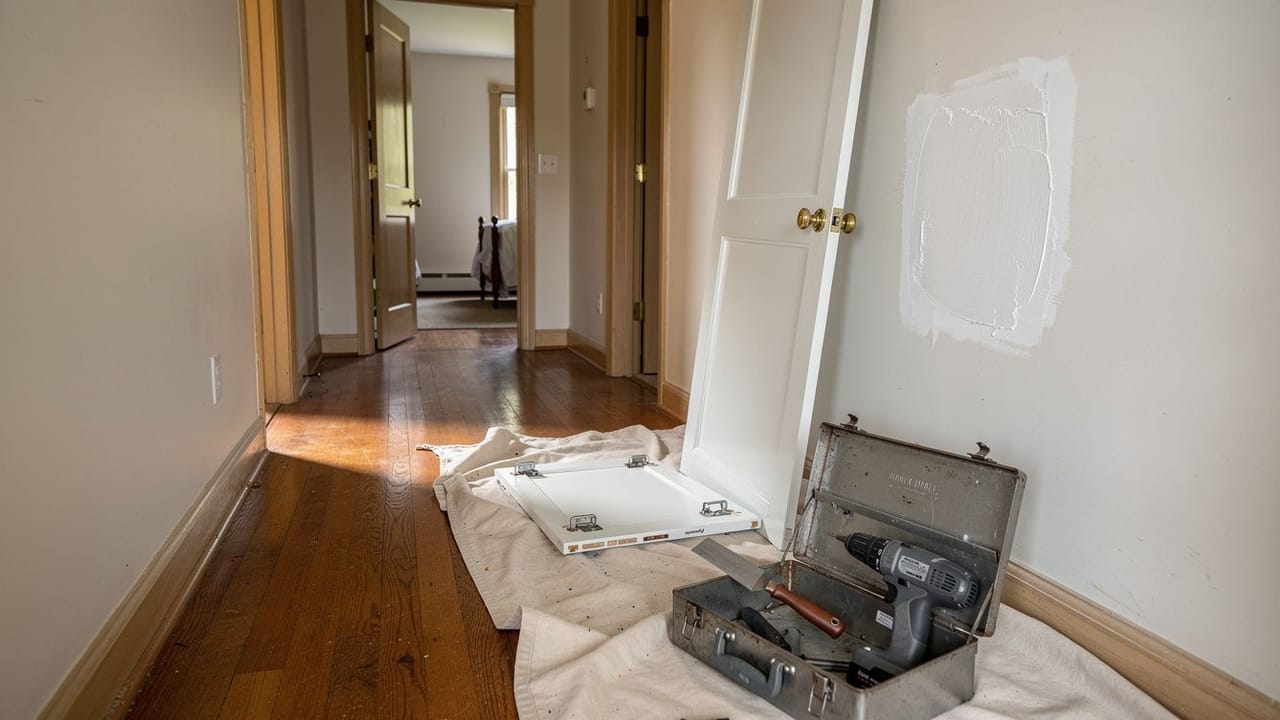
Anything small, varied, and outside the licensed trades: rehanging doors, patching drywall, fitting shelving, repairing trim, tiling a small area, adjusting cabinet doors. Most of that needs no permit in Nashville. Metro Codes’ permit table for renovating a single-family house lists no permit for replacing a door when the opening stays the same, for ceramic tile on walls, or for installing cabinets with no electrical or plumbing, though a drywall repair larger than 100 square feet does need one. That mix is what our general repairs visits are built around.
The economics are strongest on a punch list. Eight small jobs done by one person in one day means one trip, one setup and one cleanup, where eight separate specialist visits would mean eight of each.
Where the line is
On that same Metro page, the line starts to show. Relocating a fixture, switch or outlet takes an electrical permit, relocating a plumbing fixture takes a plumbing permit, and replacing a structural element such as a joist, rafter or stud takes a building permit, as does removing a wall even when it is not load-bearing. Gas and mechanical work has its own permit category in the same table.
A permit is a useful practical test, with a caveat. For electrical work in Davidson County it settles the question: Metro’s electrical licensing ordinance, as amended in 2013, requires anyone doing electrical work that needs a permit to be licensed by Metro’s electrical board or registered with Codes. For building work it settles less, because the renovation page also says an owner who lives in a single-family house, or intends to, can pull the building permit personally. Air conditioning carries a federal line of its own, since the EPA’s refrigerant sales restriction allows only certified technicians to buy refrigerant, with limited exceptions.
- Handyman: repairs, replacements in place, finishes, assembly
- Licensed electrician: moving or adding fixtures, switches and outlets, and anything in the panel
- Plumber or gas fitter: relocating or adding fixtures, and any gas line
- HVAC technician with EPA certification: anything involving refrigerant
- Roofer: a new layer, or replacing more than a third of the roof
- Contractor with a building permit: structural repairs and wall removal
The threshold question
Project size decides the rest. The Board for Licensing Contractors requires a state contractor license for projects of $25,000 or more, and that includes a subcontractor whose electrical, mechanical, plumbing, HVAC or roofing portion reaches $25,000. Below that figure, residential work is not automatically license-free. The board’s Home Improvement license page says the license applies to residential projects from $3,000 to $24,999, including repair and replacement, in the counties that adopted the law. Davidson, Rutherford and Robertson are on that list; Williamson and Wilson are not. A holder needs a $10,000 surety bond and proof of general liability and workers’ compensation insurance.
The trades have small-job licenses as well. The state’s Limited Licensed Electrician and Limited Licensed Plumber licenses cover work under $25,000 per project where the state’s Division of Fire Prevention handles permits or inspections, and the plumbing license exempts general maintenance under $500. Both pages say to check with the local government first, and Metro Nashville, as above, licenses its own electricians. Our post on what a handyman cannot legally do here walks through the jobs on the far side of those lines.
Ask what license they hold, and ask for their insurance certificate. Tennessee’s labor department says businesses in the construction industry are generally required to carry workers’ compensation for everyone, owners included, and our post on what an insurance certificate proves explains how to confirm one is current.
How do you get the most from a handyman visit?
Batch the work. Write the list, walk it with them at the start, and agree what fits in the time booked.
Have materials on site if they are specific, such as a particular tile or the cabinet pulls you picked, because a supply run is time you are paying for. When the list is written, send it to us for a free estimate and we will say which lines on it belong to a licensed trade instead.
Sources
- Metro Nashville Codes, Building Permits Central: I Want to Renovate a Single-Family Residence — Permit table: no permit for door replacement in the same opening, wall tile or cabinets without electrical or plumbing; permits for drywall repair over 100 square feet, relocating electrical and plumbing fixtures, structural elements, wall removal, roofing over a third of the roof; gas/mechanical category; owner-occupants may pull a building permit
- Metro Nashville Council, Amendment No. 1 to Ordinance BL2013-570 (Metro Code 6.20.040) — Anyone doing electrical work that needs a permit in Metro’s jurisdiction must be licensed by the electrical board or registered with Codes
- US EPA, Refrigerant Sales Restriction (Section 608) — Only EPA-certified technicians may buy refrigerant, with limited exceptions
- Tennessee Board for Licensing Contractors, Contractor — State contractor license for projects of $25,000 or more, including trade subcontractors at $25,000
- Tennessee Board for Licensing Contractors, Home Improvement Contractor — Home Improvement license for residential work from $3,000 to $24,999 in adopting counties, including Davidson, Rutherford and Robertson; repair and replacement included; $10,000 bond and insurance
- Tennessee Board for Licensing Contractors, Limited Licensed Electrician (LLE) — Covers work under $25,000 per project where the Division of Fire Prevention handles permits; check local requirements first
- Tennessee Board for Licensing Contractors, Limited Licensed Plumber (LLP) — Covers work under $25,000 per project; general maintenance under $500 exempt; check local requirements first
- Tennessee Department of Labor and Workforce Development, Who Must Carry Insurance? — Construction businesses generally need workers’ compensation for everyone, owners included
FAQ
When to Call a Handyman and When Not To — questions
Does a handyman need a license in Tennessee?
It depends on the size of the project, the county and the trade. A state contractor license applies from $25,000. In Davidson, Rutherford and Robertson counties, among others, a Home Improvement license applies to residential work from $3,000 to $24,999. Electrical and plumbing work has its own licensing below $25,000, from the state or from the city, as Metro Nashville does for electricians. A small repair under $3,000 that touches none of those trades falls below the Home Improvement license, though a city or county can have its own rules, and insurance still matters.
Can a handyman do electrical work?
Metro Nashville requires an electrical permit to relocate a fixture, switch or outlet, and in Davidson County electrical work that needs a permit must be done by someone licensed by Metro’s electrical board or registered with Codes. We send new circuits and panel work to an electrician. Metro’s permit table does not say either way about swapping a fixture on the same box, so if a job sits near the line, ask Codes or an electrician before the work starts.
How do handymen usually charge?
Ask which way the price is set: by the hour, or as a flat price for the job. Hourly suits a varied punch list; a flat price suits a single defined task. Ask too whether there is a minimum and whether travel and trips for materials are billed, since those are the parts of a bill most easily left out of a quote.
What is considered handyman work?
Repairs, replacements in place, finishes and assembly: rehanging a door, patching drywall, fitting shelving, fixing trim, tiling a small area or adjusting cabinet doors. Metro Nashville’s permit table needs no permit for most of that. Once a job moves an outlet or plumbing fixture, touches gas or refrigerant, or changes the structure, a licensed trade takes it.