
· by Michael Blair, Nashville's Handyman Service
A new knob or deadbolt either drops into the old holes or turns into an afternoon of drilling and chiseling, and the difference is in a few measurements taken before anything is bought. Most of those numbers are printed on the lock maker’s own preparation sheet.
Here is what we measure, what backset means, how the strike in the jamb is set so the door latches, and when a lock swap becomes carpentry. Changing locks and knobs is part of our general home repairs.
What do you measure before buying a new door knob?
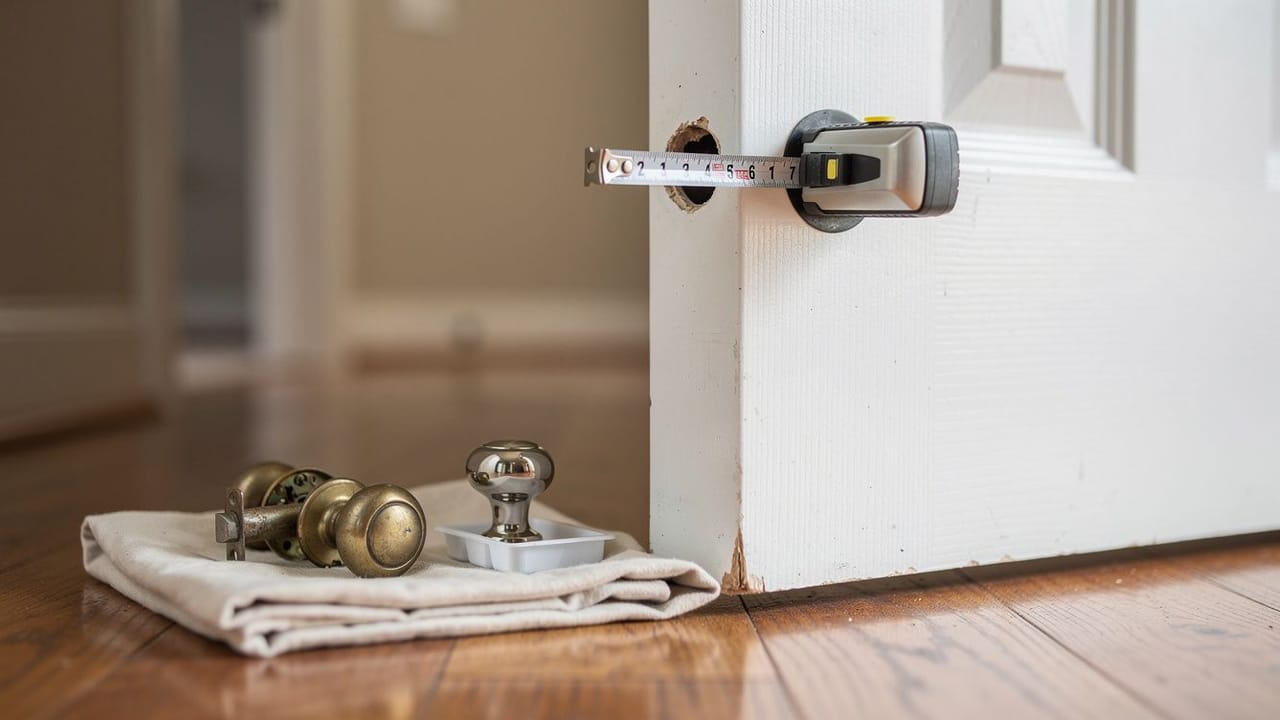
Before buying a new door knob, measure the door’s thickness, the backset and the size of the existing holes. Schlage’s door preparation instructions for a door with existing holes start with thickness: a door thinner than 1⅜ inches or thicker than 1¾ inches will not take its knobs and levers properly. The sheet then calls for a backset of 2⅜ or 2¾ inches, a 2⅛-inch hole through the face of the door and a 1-inch hole in its edge.
The holes matter in one direction only. The same sheet says that if the existing holes are larger than those sizes, the lock will not fit properly, while holes that are smaller can be opened up with a 2⅛-inch hole saw in the face and a 1-inch bit or hole saw in the edge. So we measure before the old knob goes in the trash, and take the measurements with us to buy the new one.
What is backset on a door knob?
Backset is the distance from the edge of the door to the center of the round hole the knob passes through, and Schlage’s residential locks are made for two of them: 2⅜ inches and 2¾ inches. Schlage’s sheet for preparing a new door with no holes says to choose the one that matches the other doors on site, and to mark the lock centerline 38 inches from the finished floor, or to match the other doors.
Deadbolts follow the same two backsets. Schlage’s installation instructions for its B-Series deadbolts list a backset of 2⅜ or 2¾ inches, a door 1⅜ to 1¾ inches thick, a face hole of 2⅛ or 1½ inches and a 1-inch edge hole, with the deadbolt centered 5½ inches above the knob or lever. The bolt on that model adjusts to either backset. Read the backset off the old latch or measure it before you shop, because a lock bought for the wrong one will not line up with the hole.
How is the strike set so the door latches?
The strike, the plate in the jamb the latch drops into, is set so it sits exactly opposite the latch and lets it seat fully. Schlage’s existing-holes sheet says to hold the new strike and its reinforcement plate against the jamb, and if they do not fit, to trace the faceplate, mark the holes and correct the jamb with a chisel, hammer and drill. On a new door, its no-holes sheet calls for a 1-inch hole half an inch deep for the latch and a shallow mortise so the strike reaches the edge of the jamb, where the latch lip catches it.
A deadbolt needs a deeper hole. The B-Series instructions say the strike hole must be at least 1¼ inches deep, so the bolt can throw all the way. The same sheet ends with a test we always run: lock and unlock from outside, and if it will not, take the lock off and turn the tailpiece 90 degrees before reinstalling it. A latch that still misses the strike usually points to a door that has moved, which our post on doors that stick explains.
When a lock swap becomes carpentry
A lock swap becomes carpentry when the door or the jamb no longer matches what the lock expects. A door outside the 1⅜-to-1¾-inch range, holes already bored larger than the sheet allows, a split stile around an old bore, or a jamb chewed up by years of strike changes all need wood repaired or replaced before the new hardware will hold. Adding a deadbolt where there was none means boring a new face hole and edge hole at the spacing the lock’s sheet gives.
Those repairs are finish carpentry we handle on the same visit: a filled and redrilled jamb, a dutchman in a damaged stile, or a new strike mortise cut clean. We change knobs, levers and deadbolts in Hendersonville, Nashville and across Middle Tennessee, and we can take the measurements before you buy. To have locks changed or a door that will not latch put right, ask us for a free estimate.
Sources
- Schlage (Allegion), Door Preparation Instructions for Door with Existing Holes — Door 1⅜ to 1¾ inches thick; backset 2⅜ or 2¾ inches; 2⅛-inch face hole and 1-inch edge hole; larger holes will not fit, smaller ones can be enlarged; fit and correct the strike and reinforcement plate in the jamb.
- Schlage (Allegion), Door Preparation Instructions for Door with No Holes (115799) — Backset to match other doors; centerline 38 inches from the finished floor or to match; 2⅛-inch hole saw; latch flush with the door edge; 1-inch strike hole 1/2 inch deep; strike mortise reaching the jamb edge for the latch lip.
- Schlage, B-Series Deadbolts (B60, B60CS, B60F, B62) Installation Instructions — 2⅛- or 1½-inch face hole, 1-inch edge hole, backset 2⅜ or 2¾ inches, door 1⅜ to 1¾ inches, 5½ inches above the knob or lever; adjustable bolt; strike hole at least 1¼ inches deep; test from outside and rotate the tailpiece 90 degrees if needed.
FAQ
Replacing a Door Knob or Deadbolt: Backset and Bore — questions
What are the two standard door knob backsets?
2⅜ inches and 2¾ inches. Schlage’s door preparation sheets give those two backsets for its residential knobs and levers and say to match the other doors on site. Its B-Series deadbolt instructions list the same two, and that deadbolt adjusts to either one. Measure from the door edge to the center of the round hole.
Will a new door knob fit the old holes?
Usually, if the old holes are the standard size or smaller. Schlage’s sheet for doors with existing holes calls for a 2⅛-inch face hole and a 1-inch edge hole, and says holes larger than those will not fit the lock properly. Smaller holes can be enlarged with a hole saw and bit.
How far above the door knob should a deadbolt go?
Schlage’s B-Series deadbolt instructions center the deadbolt 5½ inches above the knob or lever. The same sheet lists a 2⅛- or 1½-inch face hole, a 1-inch edge hole and a backset of 2⅜ or 2¾ inches. If an existing deadbolt hole sits elsewhere, follow the new lock’s own sheet.
How thick does a door have to be for a standard lock?
Between 1⅜ and 1¾ inches for Schlage’s standard residential knobs, levers and B-Series deadbolts, according to its preparation sheets. A door thinner or thicker than that will not take the lock properly without a different kit or model, so measure the door edge before buying hardware.
Why won’t my deadbolt lock after I installed it?
Often the strike hole is too shallow or the tailpiece is turned the wrong way. Schlage’s B-Series instructions say the strike hole must be at least 1¼ inches deep, and if the lock will not lock and unlock from outside, to remove it and rotate the tailpiece 90 degrees before reinstalling it.