
· by Michael Blair, Nashville's Handyman Service
A dryer that takes two cycles to dry a load of towels is often telling you about the duct behind it rather than the machine. Replacing that duct is a small job, but the rules for it are specific: the residential code and the dryer’s own installation instructions both say what the duct is made of, how far it can run and how it ends outside. The reason they bother is lint. In the U.S. Fire Administration’s report on residential dryer fires from 2008 to 2010, failure to clean was the leading factor in how those fires started.
What is a dryer vent duct supposed to be made of?
Smooth-walled metal, 4 inches in diameter, from the connector to the outside. Section M1502.4.1 of the Tennessee Residential Code calls for metal duct at least 0.0157 inch thick, which is No. 28 gage, with a smooth interior and a 4-inch nominal size. GE’s electric dryer installation instructions put it in plainer words: rigid or flexible metal duct of 4 inches, and never plastic or any other duct that can burn.
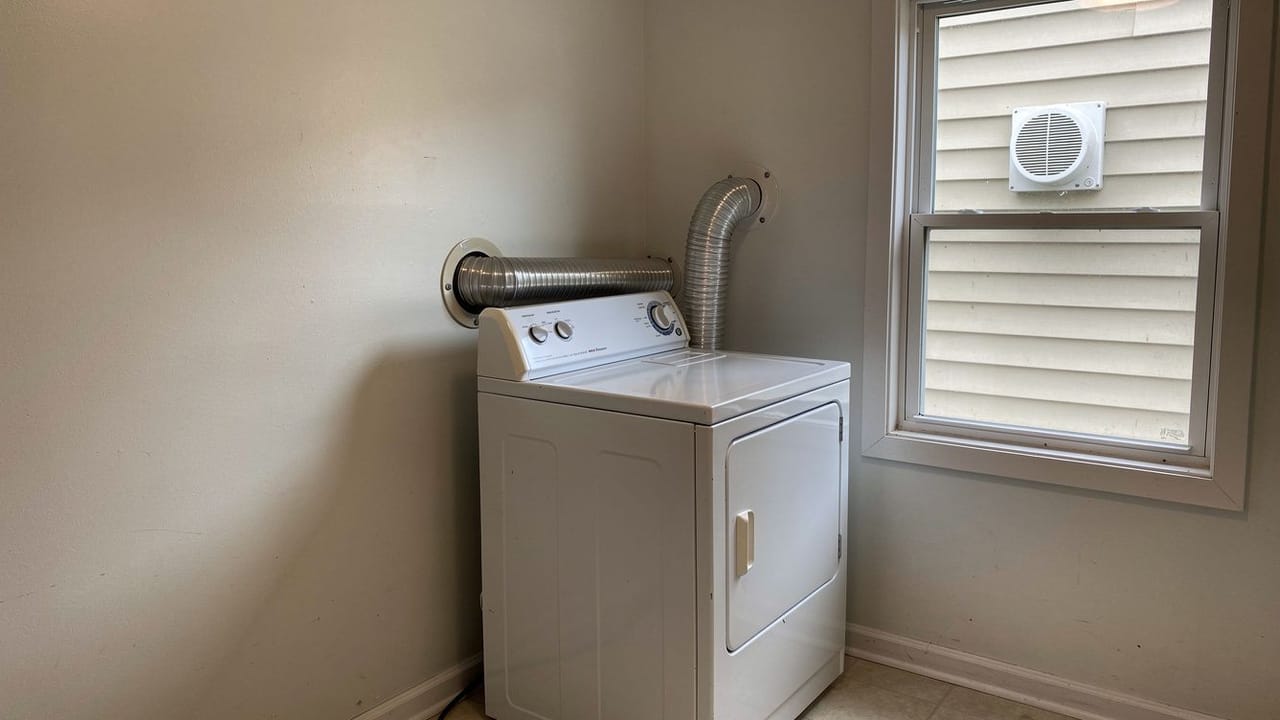
The short connector between the dryer and the wall, the transition duct, has its own rule. Section M1502.4.3 allows a single length of no more than 8 feet, listed and labeled to UL 2158A, and it cannot be hidden inside a wall, floor or ceiling. A white vinyl accordion hose meets none of that.
The rest of the run is supported at least every 12 feet, with joints sealed and mechanically fastened, and no screw at a joint can reach more than 1/8 inch into the duct, where it would catch lint (Section M1502.4.2).
How long can a dryer vent be?
Thirty-five feet of duct under the code, less for every elbow, and the dryer maker may set a lower limit. Section M1502.4.5.1 measures the 35 feet from where the transition duct connects to where the duct ends outside, and its table takes length off for each fitting; the transition duct itself does not count. Where the equivalent length runs past 35 feet, Section M1502.4.6 requires a label stating it within 6 feet of the duct connection.
GE’s chart is tighter, and it shows how much bends and flexible duct cost. It ignores a single turn of 45 degrees or less and counts two 45s as one 90, and it does not recommend more than two 90-degree turns. Your own dryer’s manual governs, so read it before a new route is planned. For a 4-inch recommended hood, GE lists:
- No elbows: 35 feet of rigid metal, or 25 feet of flexible metal
- One 90-degree elbow: 30 feet rigid, or 15 feet flexible
- Two 90-degree elbows: 20 feet rigid, or 10 feet flexible
Should a dryer vent have a screen where it ends outside?
No. Section M1502.3 says plainly that screens are not to be installed at the duct termination. The duct has to end outside the house, at least 3 feet from any opening into the building unless the dryer maker’s instructions say otherwise, and the cap needs a backdraft damper.
Outside is the important word. GE says not to end a dryer duct in a chimney, a gas vent, a crawl space or an attic, and to leave access so the whole run can be inspected and cleaned. A duct that stops under the floor or in the attic is putting lint where nobody will ever clean it out.
When is a dryer vent a handyman job?
Swapping a plastic or crushed transition hose for a listed one, replacing an old run with smooth metal duct on the same path, and fitting a proper dampered cap on an existing opening are the kind of general repairs we take on. A run that has to pass through a fire-rated wall, or anything on the gas side of a gas dryer, belongs to another trade, and we will say so when we see it. What a handyman cannot do covers where that line sits.
The USFA report on clothes dryer fires estimated about 2,900 residential dryer fires a year from 2008 to 2010, with an estimated 5 deaths, 100 injuries and $35 million in property loss each year, and it put failure to clean, at 34 percent, as the leading factor contributing to ignition. Those figures are from 2008 to 2010. A short, smooth, metal run that can be reached for cleaning is the part a homeowner controls.
It belongs on the same list as the rest of your seasonal home maintenance. We work in Hendersonville and across Middle Tennessee; send us a note with a photo of the back of the dryer and where the vent leaves the house.
Sources
- Tennessee Residential Code, Chapter 15 Exhaust Systems, Section M1502 Clothes Dryer Exhaust (via UpCodes) — Termination outside, 3 ft from openings, backdraft damper, no screens (M1502.3); 4-inch smooth metal duct, No. 28 gage (M1502.4.1); support every 12 ft, sealed and fastened joints, screws no more than 1/8 inch (M1502.4.2); transition duct UL 2158A, 8 ft, not concealed (M1502.4.3); 35 ft maximum reduced for fittings (M1502.4.5.1); length label (M1502.4.6).
- GE Appliances, Installation Instructions, Electric Dryer — Rigid or flexible metal 4-inch duct only, never plastic; length table by elbows for rigid and flexible duct; no more than two 90-degree turns; do not terminate in a chimney, gas vent, crawl space or attic; access for cleaning.
- U.S. Fire Administration, Topical Fire Report Series Vol. 13, Issue 7, Clothes Dryer Fires in Residential Buildings (2008-2010), August 2012 — About 2,900 residential dryer fires a year with 5 deaths, 100 injuries and $35 million in losses; failure to clean (34 percent) the leading factor contributing to ignition.
FAQ
Replacing a Dryer Vent: Length, Duct and the Cap — questions
What size is a standard dryer vent?
Four inches. The residential code calls for a 4-inch nominal metal duct with a smooth interior, at least 0.0157 inch thick, and dryer makers such as GE specify 4-inch rigid or flexible metal duct as well. The length limits in both are worked out for that size, so the whole run should stay at 4 inches.
Can you use flexible duct for a dryer vent?
Flexible metal duct is allowed by makers like GE, but with shorter limits: 25 feet with no elbows and only 10 feet with two. The code limits the connector behind the dryer to one 8-foot length of listed transition duct that stays exposed. Plastic or vinyl hose is not allowed by either.
Should a dryer vent be straight?
As straight and short as the house allows. Every elbow takes length off what the code and the dryer maker permit; GE drops rigid duct from 35 feet with no bends to 20 feet with two 90-degree elbows, and it does not recommend more than two. One gentle turn of 45 degrees or less is ignored.
Can a dryer vent run under a crawl space?
It cannot end there. GE’s instructions say not to terminate a dryer duct in a crawl space, an attic, a chimney or a gas vent, and the code requires the duct to end outside the building with a backdraft damper. Whatever route it takes under the house, leave access along the run for inspection and cleaning.
Is plastic dryer vent hose safe?
No. GE’s installation instructions say never to use plastic or other combustible ductwork, and the residential code calls for metal duct with only a short listed transition connector behind the dryer. If a white vinyl accordion hose is back there, replace it with listed metal transition duct and keep it exposed.