
· by Michael Blair, Nashville's Handyman Service
A grab bar is a small job with no room for error, because the day it matters is the day someone puts their weight on it. Where it goes is half the question. The other half is what holds it: a bar fastened only to drywall or tile is a towel bar with a better finish. Here is where bars go beside a toilet and along a tub, how high and how thick they should be, what the screws have to reach, and how a bar is mounted over finished tile. Installing them is part of our general home repairs.
What does a grab bar have to be screwed into?
A grab bar has to be screwed into solid framing, and for most bars that means a wood stud at each end. Delta’s installation instructions for its ADA wall grab bar say both ends must go into a stud, with at least two of the three screws at each flange passing through the wallboard or tile and tightened into the wood. Those instructions are for one bar, so for any other model we follow the sheet that comes in its box.
Delta’s sheet also allows the bar to go vertically, horizontally or at an angle, as long as those screws reach studs at both ends. So the stud layout often decides the bar’s length and position more than anything else. Before drilling, we find the studs and check for wiring and plumbing behind the wall, as the sheet tells installers to do, and it ends with a line worth repeating: if in doubt, have a qualified professional do it.
How high and how far from the wall does a grab bar go?
A horizontal grab bar goes with the top of its grip 33 to 36 inches above the finished floor, with 1½ inches of space between the bar and the wall. Those figures are from section 609 of the 2010 ADA Standards for Accessible Design, published by the U.S. Access Board. The ADA standard governs public and commercial buildings, not private homes, but it is the measuring stick installers use when a homeowner asks where a bar should go.
The same section sets a round bar between 1¼ and 2 inches in outside diameter, says the bar must not turn in its fittings, and calls for edges that are rounded and free of sharp or rough spots. It also asks that the bar, its fasteners, its mounts and the structure behind it hold a 250-pound force applied anywhere along the bar, from above or from the side. Delta rates its bar for people up to 300 pounds when installed correctly, and warns against standing, sitting or putting full weight on it.
Where do the bars go beside a toilet and along a tub?
Beside a toilet, the ADA standard puts a bar on the side wall and another behind the toilet. Section 604.5 calls for a side-wall bar at least 42 inches long, starting no more than 12 inches from the rear wall and reaching at least 54 inches out from it. The rear-wall bar is at least 36 inches long and extends at least 12 inches past the toilet’s centerline on one side and 24 inches on the other.
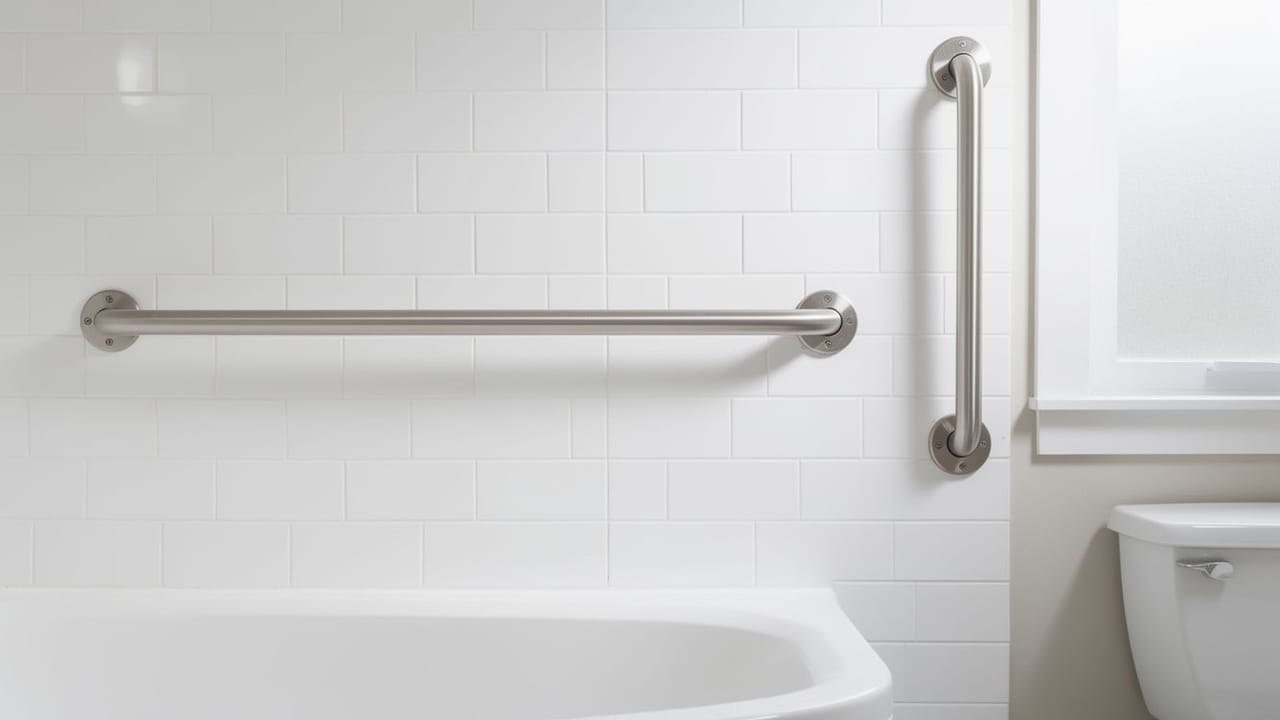
Along a bathtub with a permanent seat, section 607.4 places two bars on the back wall: one at the usual 33 to 36 inches, and one 8 to 10 inches above the tub rim. The standard also lets a dwelling unit skip the bars where the walls are reinforced for them, which is why remodelers put blocking in while the walls are open. In a finished bathroom with no blocking, we go back to the studs, and where a stud does not land where the bar needs to be, we tell you before drilling rather than settle for an anchor.
Mounting a grab bar over ceramic tile
Mounting a grab bar over ceramic tile takes two bits and some patience. Delta’s instructions call for a 1/4-inch carbide-tipped bit to go through the tile, then a 5/32-inch bit for the pilot hole into the stud, using a 3/8-inch drill, and the bar ships with six #10 wood screws 2½ inches long. We mark the stud centers on the tile first, drill through the tile with the carbide bit before switching bits for the stud, and seal each hole before the flange goes on.
Our crews put up bars beside toilets, along tubs and at shower entries in Gallatin, Nashville and across Middle Tennessee. If you are hanging other heavy things around the house, our post on hanging things on walls covers studs and anchors in general. To have bars placed and mounted, ask us for a free estimate.
Sources
- U.S. Access Board, 2010 ADA Standards for Accessible Design (sections 604.5, 607.4, 609) — Benchmark for public and commercial facilities, not private homes: bar diameter 1¼ to 2 inches; 1½ inches from the wall; horizontal bars 33 to 36 inches to the top of the grip; no rotation; 250-pound force; toilet side and rear bar lengths and positions; tub back-wall bars; dwelling units may omit bars where walls are reinforced.
- Delta, ADA Wall Grab Bar Installation Instructions (DELFAUINST01389) — One manufacturer’s instructions: both ends into a wood stud, at least two of three screws per end; any orientation if the screws reach studs; locate studs and avoid wiring and plumbing; carbide bit through tile and pilot hole; six #10 x 2½-inch screws; rated for persons up to 300 pounds; do not stand, sit or put full weight on the bar.
FAQ
Installing Grab Bars: Height, Studs and Tile — questions
Do grab bars have to hit a stud?
For most bars, yes. Delta’s installation instructions say both ends must go into a wood stud, with at least two of the three screws at each end tightened into the wood. The sheet gives no option for drywall or tile alone. Where a stud is not where the bar should go, plan around the studs or add blocking.
Where should grab bars go next to a toilet?
The ADA standard installers measure against puts a side-wall bar at least 42 inches long, starting within 12 inches of the rear wall and reaching 54 inches out, plus a rear-wall bar at least 36 inches long. The ADA standard does not bind private homes, but its layout is a sound guide.
Can you install a grab bar in a tiled shower?
Yes, through the tile and into the studs. Delta’s instructions call for a 1/4-inch carbide-tipped bit through the tile and a 5/32-inch bit for the pilot hole in the stud, with the supplied 2½-inch wood screws. Find the studs and check for pipes and wiring before drilling, and seal each hole.
Should a grab bar be horizontal, vertical or angled?
Any of the three can work if it is anchored right. Delta’s instructions allow a bar vertically, horizontally or at an angle as long as at least two screws at each end reach a wood stud. The ADA standard sets heights for horizontal bars, with the top of the grip 33 to 36 inches up.
How much weight should a grab bar hold?
The ADA standard asks that a bar, its fasteners and the wall behind it withstand a 250-pound force applied anywhere on the bar, from above or the side. Delta rates its bar for people up to 300 pounds when installed correctly and warns against putting your full weight on it or standing on it.
What diameter should a grab bar be?
Between 1¼ and 2 inches in outside diameter for a round bar, by section 609 of the 2010 ADA Standards. The same section calls for 1½ inches of space between the bar and the wall, a bar that does not rotate in its fittings, and rounded edges with no sharp or rough spots.